|
Bones of the Earth, Spirit of the Land
by Nicholas Capasso, Curator - DECORDOVA
Museum, Boston
Nick Capasso,
Ph.D., is Associate Curator at the DeCordova Museum and
Sculpture Park in Lincoln, Massachusetts. He is also an art historian,
critic, and lecturer in the fields of outdoor sculpture and public
art. In 1996, Capasso organized the DeCordova exhibition John
Van Alstine: Vessels and Voyages.
The Sculpture of John Van AlstineWhen asked to consider the intersection
of landscape and the visual arts, one immediately calls to mind
images of two-dimensional art, namely landscape painting and photography.
These two media - one ancient, and the other a product of the Industrial
Revolution - allow for both conjectural and relatively objective
pictures of our environs, seen always at some remove, as if through
a window. Or, in a more contemporary context one might consider
sculptural and architectural artworks placed within the landscape,
such as the site-specific earthworks or land art pioneered by post-Minimalist
artists Robert Smithson, Nancy Holt, Michael Heizer, and others
in the 1960s and 1970s. These works are not images, but objects
and places, inextricably tied to the land both physically and conceptually.
The sculpture of John Van Alstine occupies a unique territory, mediating
amongst image, object, and place. Van Alstine is a sculptor, first
and foremost, a maker of impermeable, obdurate, and often monumental
objects. These objects, however, also have an imagistic quality,
complete with the representational, associational, and metaphoric
qualities inherent to pictures. Yet at the same time they speak
strongly of place, in microcosmic and macrocosmic terms. Geology
and cosmology collide. Narratives about and within landscapes are
layered like sediment. Van Alstine mines the earth to excavate its
beauty, its terrors, and its potential for the expression of powerful
and subtle aspects of the human condition.
Even in Van Alstine's two-dimensional work - pastel drawings and
color photography - his concern for the landscape as stage and actor
is pre-eminent. This is not to imply that the artist's work is entirely
delimited by his perceptions of the land. He deals also with the
figure, the monument, abstraction, assemblage, storytelling (particularly
myth), cultural history, and natural history; but a sense of the
land, its gravity and embrace, its settings and stories, is the
ground upon which all else rests.
SCULPTURE
The hard root of the land is stone, and for Van Alstine, "stone
is everything," the physical and metaphysical basis of all
his work. None of his sculptures are without a stone, or the image
of a stone. Stone is the earth and the land, stone is terra firma.
Van Alstine uses stone as a place, a home, a figural presence, and
a magical transformational material. Stone marries nouns and verbs,
and dissolves the dualism of image and object.
Van Alstine grew up with stone, and lived close to the land, in
the Adirondack Mountains. He saw rocky promontories, glacial granite
boulders, stone walls, and split-stone fences in his boyhood travels
through upstate New York and northern New England. As an art student,
he saw stone as the foundation of the history of sculpture, and
began to believe passionately that "stone is sculpture."
Deeply impressed by the works of the ancients, he found compelling
parallels in Modernist sculpture. Van Alstine began his career as
a sculptor of stone by emulating the great abstract carvers of the
twentieth century: Constantin Brancusi, Hans Arp, and Henry Moore.
He chose white Vermont marble as his first medium for its softness,
purity, and malleability, and with it he carved sinuous, sensual,
biomorphic abstractions. Many of these works, like those of his
chosen predecessors, referenced the figure with their verticality
and suggestions of human corporeality, but many also were bound
up with the land. One of his earliest sculptures, Gaea (1973) is
an homage to Mother Earth, while the roughly parallel edges in works
like Vertical Series #3 (1974) were directly inspired by the tracks
of skis in virgin snow (Van Alstine had been a competitive skier
in his youth).
Soon, however, the young artist's interest drifted from the finely
wrought elegance of early Modernism to the rough-hewn rocks used
by sculptors like Isamu Noguchi. Van Alstine's intentions changed
and matured. He was no longer interested in carving stone to reveal
something else, but in allowing stone to retain its integrity, its
natural weight, density, and texture. By respecting the stone, and
allowing it to speak for itself on its own terms, Van Alstine was
able to summon forth a new and wide range of content. At the same
time, he shifted his process from the subtractive method of carving
to the additive method of collage in three dimensions. In 1975,
he embarked upon a series of Stone Assemblages. These were large-scale
outdoor agglomerations of rough-cut stones, straight from the quarry.
To these he sometimes added wood and steel elements in sprawling
compositions that dealt with the formal tensions among the three
disparate materials.
With the Stone Assemblages, Van Alstine laid out the beginnings
of the material, procedural, and compositional underpinnings of
all his later work.
In 1976, John Van Alstine moved to Laramie, Wyoming to accept a
teaching post at the local State University. While there, his love
of raw stone deepened, and his interest in landscape intensified.
In Wyoming he saw the land stripped bare, and saw clearly for the
first time the awesome power of nature as sculptor. The rocks of
his boyhood back east had been nestled in soil, swaddled by greenery,
and framed by the closely compacted rolling topography. Out West,
aridity, erosion, and the vast and stark lay of the land combined
to produce an unfamiliar sublimity. Mountains, buttes, stone arches,
glacial scars, exposed geologic layering, and colossal boulders
loomed about him and the real danger of rockslide and avalanche
was ever present. The bones of the earth protruded from its desiccated
flesh, and the landscape seemed a place fraught with potent and
perilous tensions.
In a new body of work, the Nature of Stone series, Van Alstine set
out to express his perceptions of this environment. He assembled
huge sculptures using nothing but giant slabs of Colorado flagstone
and forged steel rods. No pins or welds hold these materials together.
Their structural integrity depends upon actual physical forces held
in precise tensions and balances. In his Stone Piles, Arches, Torques,
and Props, the artist interlocked conflicting masses and weights
in arrested motions that strain with potential energy. They are
visually and physically precarious - their crushing capabilities
are palpable - and their scale and compositions echo the exposed
geology of the Western landscape. The Nature of Stone works explore
not only the bald facts of rock, but also deal with the tortuous
forces that underlie the landscape, the primeval tectonic writhing
of the Earth itself and its potential for extreme physical danger.
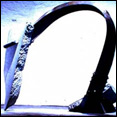 |
| Los Arcos, 1983 |
In the Nature of Stone, Van Alstine worked within the then-current
tenets of post-Minimalism, in which sculptors used minimal, predominantly
geometric forms and the direct properties of materials to elicit emotional
responses, often on a quite visceral level. In his next body of work,
Van Alstine set himself completely apart from his art historical roots
and his contemporaries. In 1980 he moved back to the East Coast to
teach at the University of Maryland. Shortly after his return, he
created a pivotal new sculpture, In the Clear (1983). This artwork
again brings stone and steel together, but now in harmony rather than
strident discord. The stone and steel elements embrace, and work together,
rather than seeming to try to pull each other to pieces. They dance,
rather than fight. Moreover, In the Clear refers not so much to the
structural properties of the landscape, but more to a sense of place.
This place is, to be sure, non-specific and highly abstracted, but
it seems a place upon the land rather than a force within the earth.
Van Alstine even went so far as to craft a vertical steel element
that suggests vegetation.
In subsequent sculptures, these direct landscape allusions proliferated
as Van Alstine continued to introduce aspects of imagery within his
dynamic formal and material assemblages.
In Drastic Measures (1984-87) and Luna (1985), the artist began experimenting
with applied color and quasi-representational shapes, to suggest plant
forms, and the moon and sky, respectively. In Los Arcos (1985), the
soaring steel member that unites its stone foundations makes conscious
reference to gigantic natural stone arches. And the compositions of
all of these sculptures suggest vignettes within the landscape, places
that can be imaginatively inhabited, and that are affectively distinct
from each other. In contrast to the Nature of Stone series, these
works are lighter, playfully evocative, and reflect the artist's fond
memories of Western places rather than his direct experience of the
powers of that land.
In the late 1980s and 1990s, Van Alstine arrived at the style and
themes for which he has become best known. He continues to juxtapose
stone and steel, but has added found objects and bronze castings of
stones and found objects to his set of assembled elements. The work
is ever more imagistic (especially given the presence of objects from
the real world) and increasingly narrative. The landscape vignettes
of the early 1980s seemed in part like empty stage sets waiting for
players and actions. Now, mythological and metaphorical tales are
told in sculptures wherein the distinctions between image/object/place,
and actor/action/stage, are marvelously blurred.
Two primary themes in this recent work involve tools and vessels,
and both are tied to Van Alstine's abiding concern with the land.
Struck by the collection of nineteenth-century tools at the Smithsonian
Institution's National Museum of American History, and following an
art- historical precedent established by David Smith and Jim Dine,
Van Alstine began to include actual utilitarian implements in his
sculptural compositions. He was most drawn to agricultural tools -
tools that help to work the land - and juxtaposed objects like rakes,
plow blades, saws, and anvils with his ever-present stones in celebration
of the joys and hardships of bending the land to one's will. Not surprisingly,
he was particularly interested in the sledge, an antiquated conveyance
on runners used for hauling stone over rough ground. In Van Alstine's
Sledges, massive rock slabs become carrier and cargo, both the landscape
and the laborious traversing of the landscape.
 |
 |
 |
| Sledge 1992 |
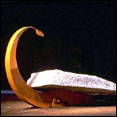
Charon's Steel Styx Passage, 1996 |
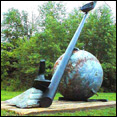
Tether (Boy's Toys), 1995 |
The Sledges - stone boats - also relate to Van Alstine's simultaneous
involvement with the idea and image of vessels. The vessels - often
with nautical associations that turn his sculptures into abstracted
seascapes - involve metaphorical journeys across space, time, and
place. Marine scrap yards in Jersey City, New Jersey, where the artist
had relocated his studio, provided buoys, cleats, chains, oars, floats,
and boats, to juxtapose with slabs of stone. In works like Tiller
(1994), the stone flies aloft like a magical sail, and in the mythically
titled Atlas (High Roller) (1995), Labyrinth Trophy (1996), and Charon's
Steel Styx Passage (1996), the stones provide earthbound anchors for
sweeping, orbital narratives that link land, sea, and sky, as well
as ideas surrounding the boundaries between life and death. Other
vessel sculptures address a type of transportation that is as technological
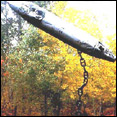
as it is mythological. In Tether (Boys Toys) (1995), a huge airplane
fuel tank that resembles nothing more than a missile rises above a
puny earth, and in Sacandaga Totem (1997), a central stone pylon provides
the shaft to a rocket whose vertical aspiration is forever held in
check by its mass. Works like these indicate Van Alstine's concern
with the fate of the land, and of the earth, in the face of unchecked
science and industry. Taken as a whole, the recent sculptures that
involve tools, vessels, and voyages sum up and extend the formal and
conceptual issues explored in Van Alstine's earlier work. They also
establish places of contemplation not about landscape per se, but
about humanity's many physical, cultural, and spiritual relationships
with the land and our planetary home.
A great many of Van Alstine's recent sculptures are intended for outdoor
display, and the grounds that encompass his current studio in Wells,
New York (back in the Adirondacks) are filled with new work. In this
rural setting, framed by mountains, dense foliage, and a river, the
artist wrestles with issues of size, scale, placement, and sight lines
so that he fully understands each sculpture's potential for outdoor
display. His goal for all of his outdoor sculptures is to address
not only the landscape intrinsically, but extrinsically as well, in
direct dialogue with the natural features that surround them. Although
not entirely site-specific, Van Alstine's sculptures large scale outdoor
works do elicit meaning through their juxtapositions with existing
landscapes, and also transform places from the mundane to the magical.
PUBLIC ART
John Van Alstine's long involvement with placing sculpture in the
outdoors has led him on a number of occasions to accept commissions
for works of public art. These sculptures, chosen through competitions
and sited in public places, extend the artist's concerns with the
landscape by introducing site-specificity and conceptually linking
terrestrial place with cosmological space.
 |
 |
| Trough, 1982 |
Solstice Calendar, 1985-6 |
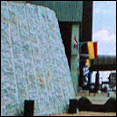
His first public sculpture was Trough (1980-82), commissioned by the
city of Billings, Montana to commemorate the 100th anniversary of
its founding. Trough consists of two mammoth leaning slabs of granite,
connected and supported by linear steel members, and could be considered
as the monumental culmination of the Nature of Stone series with its
references to geologic place, time and motion. But Trough exists as
something more. Its title and the relative positions of its stones
refer directly to the steep Yellowstone River valley into which Billings
is wedged.
The sculpture echoes the local rural sublimity of place in a downtown
urban space.
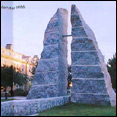
Van Alstine's next commission, Solstice Calendar (1985-1986), for
Austin College in Sherman, Texas introduced a new and enduring theme
to his public work: stone as a physical and conceptual mediator between
earth and the heavens. Solstice Calendar is a pair of colossal rough
Texas granite pylons that straddle a long horizontal stone member.
Every day at noon the sun passes between the pylons, and a steel bar
located high up between the pylons casts its shadow on the stone below.
This stone is marked to indicate the annual solstices and equinox.
This simple calendar was influenced by Van Alstine's study of ancient
archaeoastronomic architecture in the British Isles and Meso-America,
and by the work of contemporary land artists who also created
monumental yet basic solar calendars. Solstice Calendar not only locates
the Austin College campus in space and time, it also bridges academic
disciplines often deemed mutually exclusive by inhabiting a site directly
between the school's arts and sciences buildings.
 |
| Artery Sunwork, 1993 |
In Sunwork (1989-1992), created for the Institute of Defense
Supercomputer Research Center in Bowie, Maryland, a soaring stainless
steel gnomon projects from a massive chunk of earthbound granite.
Here Van Alstine created another sculpture that acts as a scientific
instrument, but in keeping with its high-tech site, Sunwork is more
advanced and precise. It acts as a clock as well as a calendar.
In stone pavement around the sculpture, lines mark out the hours
of the day like a conventional sundial. Moreover, on a long horizontal
surface, an anelemma is inscribed. This diagram, shaped like an
elongated figure 8, shows the declination of the sun and equation
of time for each day of the year, corrected for the precise longitude
of the site. When the shadow of the tip of the gnomon strikes the
anelemma, it registers noon on any given day. Van Alstine's primitive
mathematical/cosmological computer helps locate this place in cultural
history, as well as within the landscape and the cosmos.
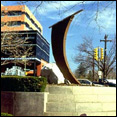
Sunwork was followed in 1993 by Artery Sunwork, in Bethesda, Maryland.
This sculpture combines the formal and conceptual concerns of its
two calendrical predecessors. Sited in a plaza along a heavily trafficked
urban avenue, Artery Sunwork consists again of an anchoring stone
that supports a soaring vertical element: an aspiring bronze arc
surmounted by a stainless steel gnomon. The shadow of the gnomon,
as it touches a precisely demarcated face of the bronze element,
indicates solstices and equinox. The sculpture thus carries a consciousness
of the relationships of place to earth to sky into the hustle and
bustle of downtown where such grounding truths are often ignored
or forgotten in a welter of streets, signs, lights, advertisements,
and architecture.
WORKS ON PAPER
Drawings
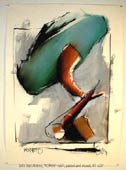
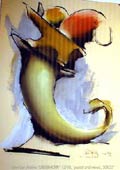
Throughout the history of art, sculptors have created drawings that
relate to their three-dimensional work, and John Van Alstine is
no exception. His drawings are large, richly colored pastels that
are neither working drawings for sculptures in process, nor two-dimensional
representations of finished works. They exist as separate and distinct
works of art, informed by and informing, but not necessarily tied
to, specific sculptures. Van Alstine uses drawing to further explore
his interest in the potential of imagery for expression. When images
occur in his sculptures - of tools, of vessels, of figures, of places
- the sheer physicality of objects imposes certain limits. But in
the illusionistic world of the two-dimensional, objects and images
are freed from the laws of nature. Without gravity, density, weight,
or friction, new and more dynamic juxtapositions and compositions
are possible, and narratives become more dramatic. Potential energy
explodes into kinetic energy. Objects teeter, swirl, loom, lurch,
and lean. The landscape comes alive, dances, runs, leaps, and turns
itself inside-out in paroxysms of joy and terror.
|
 |
 |
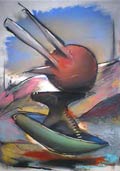
Sphere with Spikes |
Konos |
Greenhorn |
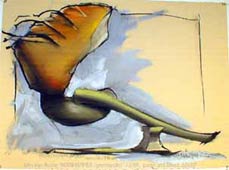 |
Hornhammer (green
handle) |
Photographs
Tellingly, between 1976 and 1980, when Van Alstine was experiencing
and expressing the powers within the Western landscape in sculpture,
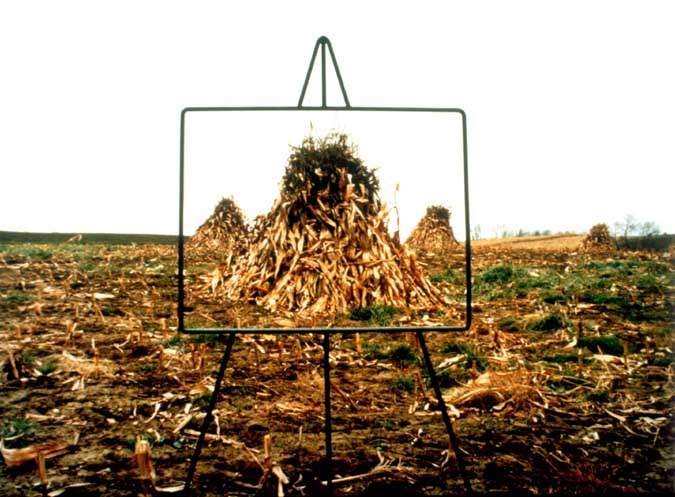
he created a portfolio of photographs: the Easel Landscapes. These
18 x 24-inch color C-type prints are united by the presence in each
image of a flat and centered sculpted steel easel that frames particular
features within larger compositions. Made in and en route to and
from Wyoming, the Easel Landscapes provided the artist with a disciplined
process for literally focusing on the landscape, and they contain
some of his favorite landforms that reappear in his sculpture. As
works of art in their own right, however, they deal with multiple
issues germane to the intersections of photography and the landscape.
Their multiple nested frames (easel, photograph, paper mat, frame)
play tricks with perspective cues, and collapse or telescope perceived
distances, calling into question how the eye and mind perceptually
process the landscape via photography. The Easel Landscapes also
wryly comment on how the landscape is figuratively framed by photography,
experience, memory, art history, and popular culture.
|
 |